Improve Conversion Rates: Turning Website Visitors Into Paying Customers
Traffic without conversion is wasted budget. A practical UK guide to conversion rate optimisation, speed, messaging, calls to action, forms and testing.
The conversion problem hiding in plain sight
Many UK businesses invest heavily in driving traffic, SEO, Google Ads, social, only to see visitors arrive and leave without enquiring. The traffic looks successful in analytics; the enquiries tell a different story. This is the conversion problem, and it's often the most expensive gap in a marketing strategy.
Here's the maths that makes conversion so important: if your landing page converts 2% of visitors, doubling it to 4% doubles your leads without spending another penny on traffic. Conversion rate is the multiplier on every pound you invest in attracting visitors, which is why improving it delivers the highest ROI of almost any marketing activity.
Conversion rate optimisation (CRO) is the systematic process of improving your website so a higher percentage of visitors take the action you want. It replaces guesswork with data, testing, and proven principles of how people actually behave online.
Speed: the conversion factor you can't ignore
Page speed is one of the strongest conversion factors, and one of the most neglected. Studies consistently show conversion rates drop sharply as load times climb past two or three seconds. A visitor who waits is a visitor who leaves, often before the page even fully loads.
Speeding up a slow site is frequently the single quickest conversion win available. It also helps SEO, since Google uses speed as a ranking factor. Yet many UK business sites are bloated with large images, unnecessary scripts, and heavy plugins that needlessly slow them down.
A fast site loads in under two seconds on a mobile connection. If yours doesn't, speed optimisation should be your first CRO priority, it improves conversion, SEO, and user experience simultaneously.
Clarity: the three-second test
When a visitor lands on your page, they make a near-instant judgement about whether they're in the right place. Within three seconds, they should know: what you do, who it's for, and why they should care. If they can't answer those questions instantly, they leave.
This clarity comes from a sharp, specific headline that speaks to the visitor's problem, supported by a clear subheading and immediately visible value proposition. Generic headlines like 'Welcome to our company' fail this test; specific ones like 'We help UK homeowners cut their energy bills by 30%' pass it.
Every page should pass the three-second test. If a visitor can't quickly confirm they're in the right place, no amount of clever design further down the page will save the conversion.
Calls to action: make the next step obvious
A clear, prominent call to action (CTA) is the bridge between interest and enquiry. Yet many sites bury their CTAs, make them vague ('Learn more'), or surround them with competing options. Each of these reduces conversion.
Effective CTAs are specific ('Get your free quote'), prominently placed (above the fold and repeated naturally down the page), visually distinct, and singular, one clear action, not a menu of choices. The visitor should never have to think about what to do next.
We test CTA wording, placement, colour, and frequency to find what converts each audience. Small changes to CTAs often produce outsized conversion lifts, because the CTA is where interest becomes action.
Forms: balancing ease and qualification
Your enquiry form is where conversion ultimately happens, or doesn't. Long, intimidating forms reduce conversion; forms that are too short produce unqualified leads. The art is finding the right balance for your business.
Generally, shorter forms convert better. Ask only for what you genuinely need to make first contact. Multi-step forms, which break a longer form into easy steps, often convert better than a single long form, because each step feels manageable.
We test form length, field selection, and structure to find the configuration that maximises both conversion rate and lead quality. The right form captures enough to qualify without creating friction that loses the enquiry.
Trust signals: reducing perceived risk
Enquiring with a new business feels risky to a customer, will they be reliable? Will they deliver? Trust signals reduce this perceived risk and measurably increase conversion. Reviews, case studies, accreditations, professional design, and clear guarantees all help.
The key is placement: trust signals should appear at the moments a visitor is deciding whether to act, near calls to action, on contact pages, beside forms. Burying reviews on a separate page few visit wastes their conversion power.
A steady stream of genuine reviews is particularly powerful, it signals both trustworthiness and that yours is an active, established business. We help build review generation processes that feed both conversion and local SEO.
A/B testing: replacing opinion with data
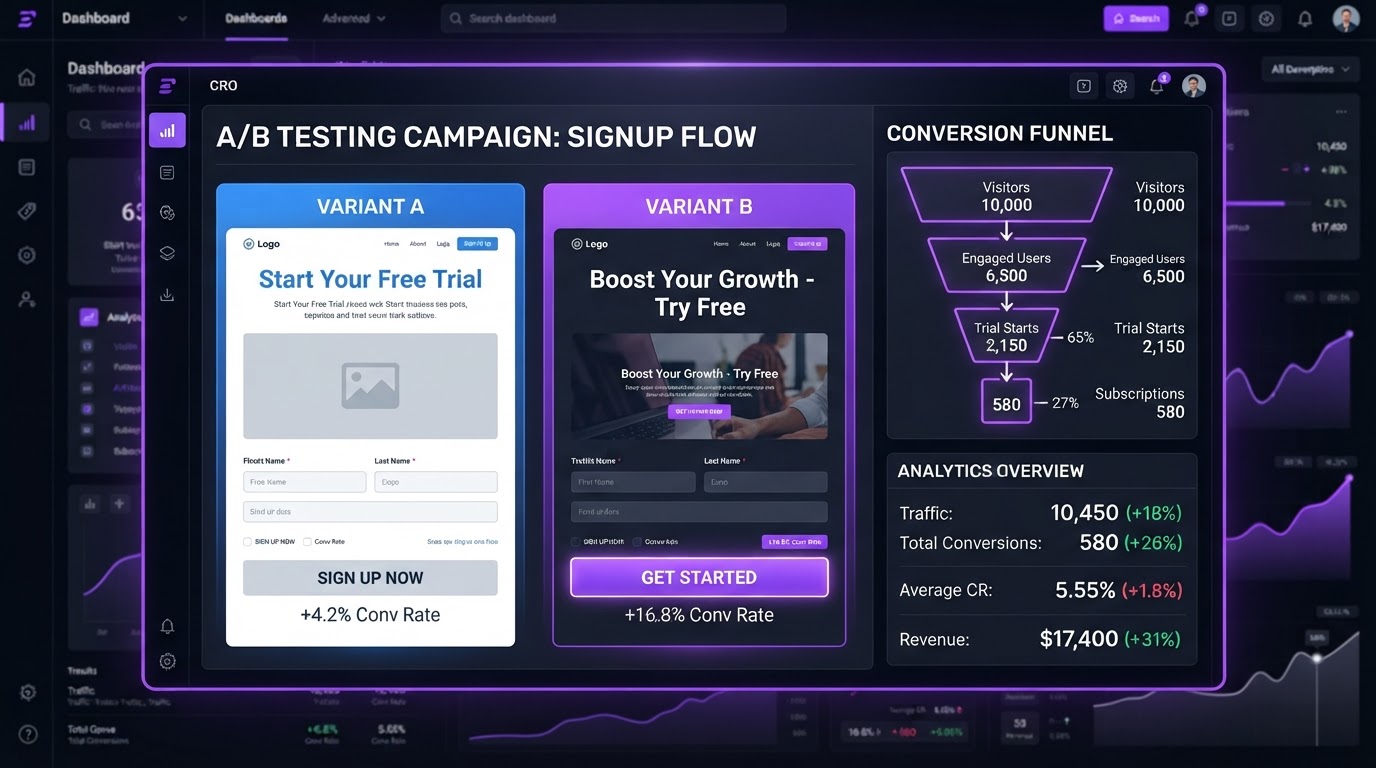
The most reliable way to improve conversion is A/B testing, showing different versions of a page element to real visitors and measuring which converts better. This replaces opinion and guesswork with hard data about what actually works for your audience.
We test headlines, layouts, CTAs, form variations, images, and copy, one element at a time, so we know exactly what drove any change. Even small tested improvements compound: a series of 10% lifts across several elements can double overall conversion.
Testing requires enough traffic to produce statistically significant results, which is why CRO pairs so well with paid traffic. But even lower-traffic sites benefit from testing the highest-impact elements like headlines and CTAs.
Measuring conversion properly
Conversion rate only matters if you're measuring it accurately, and many UK businesses aren't. Proper conversion tracking means tracking actual enquiries (form submissions, calls, CRM entries), not just page views or clicks.
We implement proper goal and conversion tracking, then measure conversion rate by source, page, and device, so you know exactly where conversion is strong and where it leaks. This data drives every CRO decision.
CRO is one of the highest-ROI activities in digital marketing because it multiplies the value of traffic you're already paying for. If you're getting visitors but not enough enquiries, conversion is almost certainly the gap, and a free CRO review will pinpoint exactly where to start fixing it.
Related Services
Improve Conversion Rates: Your Questions Answered
The exact questions UK business owners ask, including the terms people type into AI search assistants.
Ready to act on what you've read?
Get a free, no-obligation marketing review tailored to your business. A UK specialist will analyse your online presence and show you exactly how to apply these principles, within 24 hours.
Or call us: 03333 356780Request Your Free Review
Clear, actionable insights into your marketing performance.
Related Articles
Why Bespoke Website Design Outconverts Templates For UK Businesses
Template websites look fine but convert poorly. Here's why bespoke, mobile-first, conversion-engineered web design delivers measurably more enquiries, and what to demand from your next build.
Read Article
Generate More Leads: Building A System, Not Just Running Ads
More leads come from a joined-up system, capture, qualification, instant follow-up and nurturing, not isolated tactics. Here's how to build a lead engine that doesn't leak.
Read Article
How To Increase Website Traffic: A Multi-Channel Approach That Actually Works
More traffic comes from combining SEO, AI search and PPC, not betting on one channel. A UK guide to building sustainable, high-quality website traffic.
Read Article