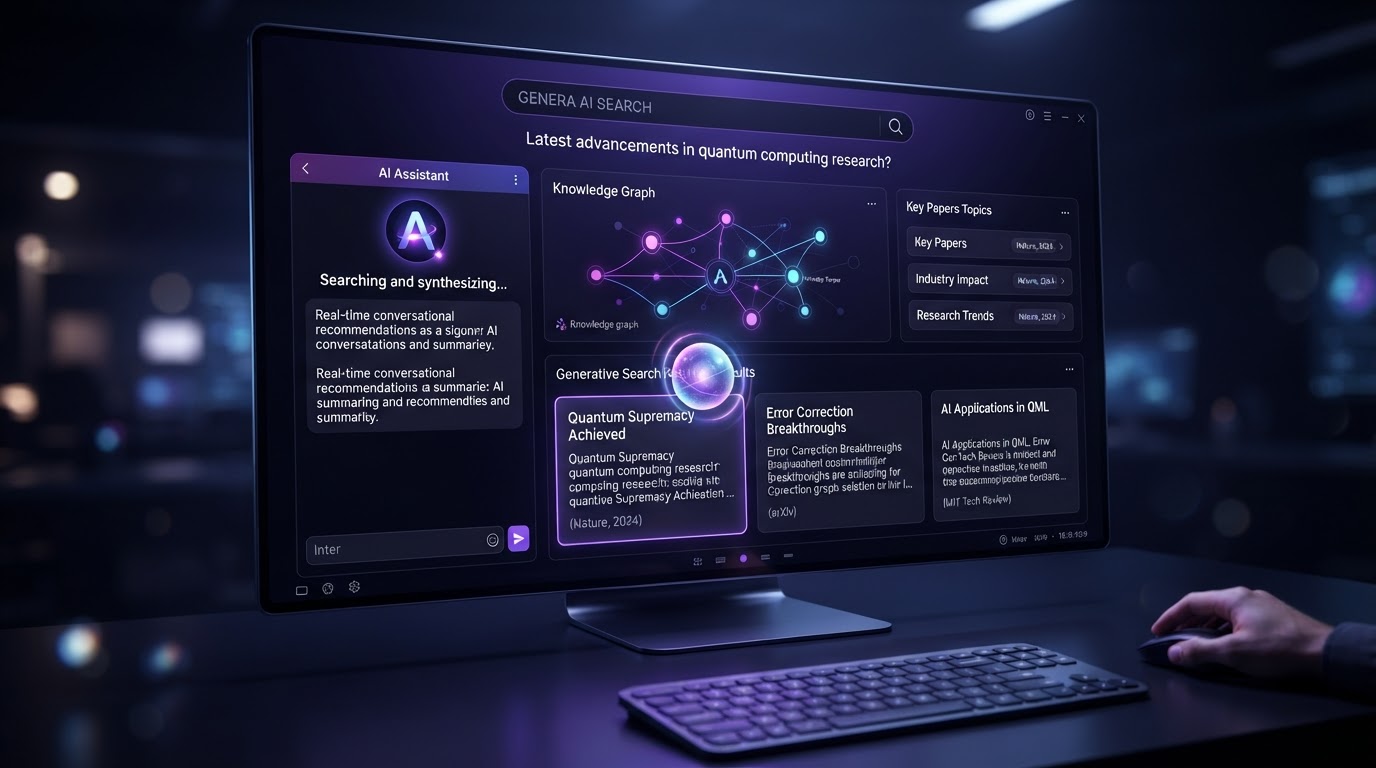
How To Prepare Your UK Business For AI Search & ChatGPT Recommendations In 2026
Generative Engine Optimisation (GEO) is changing search. Learn how entity signals, schema, and authority citations ensure your business gets recommended by ChatGPT, Perplexity and Google AI Overviews.
The search shift you can't afford to ignore
When a prospective customer wants a supplier today, there's a growing chance they don't scroll Google's blue links. They ask ChatGPT, Perplexity, or Google's own AI Overviews for a recommendation, and trust whatever the AI says. If your business isn't being cited in those answers, you're invisible at the exact moment a buying decision is being made.
This is the AI search revolution, and it's happening faster than most UK business owners realise. The question isn't whether to prepare for it, but how quickly you can position your business to be the one AI engines recommend.
What is Generative Engine Optimisation (GEO)?
Generative Engine Optimisation, or GEO, is the practice of structuring your brand and content so that AI models cite and recommend your business in their generated answers. It builds on traditional SEO but shifts the focus toward the signals AI models use to decide who to trust and reference.
Where traditional SEO targets keyword rankings and clicks, GEO targets being named as the source inside a generated answer. There may be fewer direct clicks, but the trust value of being the AI's recommended answer is enormous, it positions you as the default choice before the customer even visits a website.
How AI models decide who to cite
AI engines don't cite businesses at random. They reference sources they trust, and trust is built through a combination of clear, authoritative content, consistent brand entities, structured data, and coverage across reputable third-party sites.
Authoritative, well-structured content
AI models favour content that clearly and comprehensively answers a question. Concise, fact-rich, well-organised pages with clear headings and definitive statements are far more likely to be quoted than vague, rambling content. This is why answer-focused writing matters more than ever.
Consistent brand entities
AI models build a conceptual understanding of your business, its name, services, location, and reputation, from signals across the web. Consistent information across your site, directories, and profiles helps the AI confidently understand and recommend you.
Structured data and schema
Schema markup tells search engines and AI models exactly what your content means, this is a service, this is the price, this is the location. Structured data removes ambiguity and makes your business easy for AI to reference accurately.
Third-party authority signals
Being mentioned on reputable, independent sites reinforces your authority. Reviews, industry directories, press coverage, and genuine citations all signal to AI models that your business is established and trusted.
Google AI Overviews: the hybrid opportunity
Google's AI Overviews appear above traditional search results, generating a summary answer with cited sources. Appearing in an Overview puts your brand in front of searchers before they even see the organic results, a powerful position.
The good news is that the foundations for AI Overviews overlap heavily with strong traditional SEO: authoritative content, schema, E-E-A-T signals, and clear answer-friendly formatting. Investing in one strengthens the other, which is why we treat AI SEO and traditional SEO as a single integrated programme.
Is AI search replacing Google?
Not replacing, but reshaping. Google still processes billions of searches daily, and traditional rankings remain valuable. But a meaningful and growing share of research queries now start or end in AI assistants, and Google itself is folding AI answers into its results.
The smart approach is to be visible everywhere: ranking in traditional Google results AND being cited in AI answers. Businesses that invest only in traditional SEO risk losing visibility as behaviour shifts; those that prepare for both stay ahead.
A practical AI search preparation checklist
Preparing for AI search doesn't require a complete overhaul, it requires getting specific signals right. Here's what to focus on, in priority order.
Audit your current AI visibility
Before optimising, find out where you stand. Search for your services in ChatGPT, Perplexity and Google AI Overviews and see whether, and how, your business appears. This baseline tells you what to fix.
Structure your content for answers
Rewrite key pages to answer questions directly and concisely. Lead with the answer, then expand. Use clear headings that match how people phrase questions to AI. Definitive, useful content gets cited; vague content doesn't.
Implement comprehensive schema
Add structured data for your business, services, FAQs, and content. Schema removes ambiguity and helps AI models reference you accurately. This is one of the highest-impact, lowest-cost AI SEO wins.
Build consistent brand entities
Ensure your business name, services, and location are consistent across your site, Google Business Profile, directories, and social profiles. Consistency helps AI models build a confident understanding of who you are.
Earn genuine third-party authority
Pursue real reviews, industry mentions, and coverage on reputable sites. These signals reinforce your authority for both AI engines and traditional search. Avoid cheap, artificial link schemes, they increasingly harm rather than help.
How long does AI SEO take?
Early citations can appear within two to four months as structured signals are indexed and authority builds. Broader, consistent visibility compounds over four to six months. Because AI models continuously re-train and re-cite, the work you do now delivers growing returns over time rather than a one-off result.
The businesses that start now will have a meaningful head start as AI search grows. Those that wait will find themselves competing against established, well-structured competitors who are already being recommended.
Measuring AI search success
AI SEO success is measured by citation presence, how often and how favourably your business appears in AI-generated answers. We track this through targeted prompt testing and visibility monitoring across the major AI engines, so you can see whether your investment is translating into recommendations.
Combined with traditional SEO metrics, organic traffic, rankings, enquiries, this gives you a complete picture of your search visibility across both the classic and generative landscape.
Your next step
AI search isn't a future trend to watch, it's a present reality to act on. The businesses that position themselves now will be the ones AI engines recommend for years to come. The first step is understanding where you currently stand, which is why we offer a free AI visibility audit.
We'll test whether your business appears in AI answers for your key services, identify the gaps, and show you exactly what to fix first. No obligation, no jargon, just a clear picture of your AI search readiness and a practical plan to improve it.
Related Services
AI SEO: Your Questions Answered
The exact questions UK business owners ask, including the terms people type into AI search assistants.
Ready to act on what you've read?
Get a free, no-obligation marketing review tailored to your business. A UK specialist will analyse your online presence and show you exactly how to apply these principles, within 24 hours.
Or call us: 03333 356780Request Your Free Review
Clear, actionable insights into your marketing performance.
Related Articles
The SEO Foundations Every UK Business Needs In 2026
Ranking on Google isn't about tricks, it's about getting the fundamentals right. A practical guide to the technical, content and authority foundations that drive sustainable organic growth.
Read Article
Why Bespoke Website Design Outconverts Templates For UK Businesses
Template websites look fine but convert poorly. Here's why bespoke, mobile-first, conversion-engineered web design delivers measurably more enquiries, and what to demand from your next build.
Read Article
Improve Online Visibility: How To Make Your UK Business Impossible To Miss
Visibility is about being found everywhere your customers look, Google, the Map Pack, AI answers, and trusted sites. A UK guide to dominating your online presence.
Read Article